Seal Your Heating and Cooling Ducts
Ducts are used to distribute conditioned air throughout houses with forced-air heating and cooling systems. In typical houses, about 20 percent of the air that moves through the duct system is lost due to leaks, holes, and poorly connected ducts. The result is an inefficient HVAC system, high utility bills, and difficulty keeping the house comfortable, no matter how the thermostat is set.
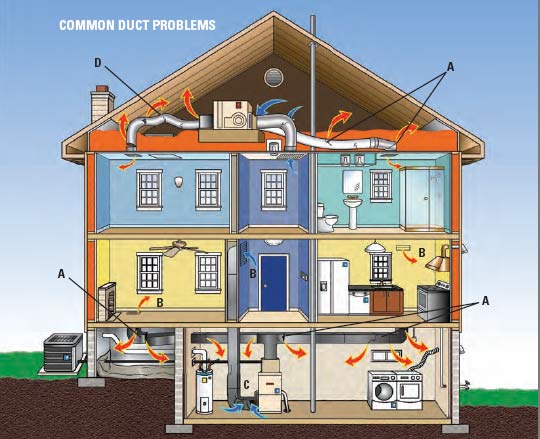
Common Duct Problems
- A Leaky, torn, and disconnected ducts
- B Poorly sealed registers and grills
- C Leaks at furnace and filter slot
- D Kinks in flexible ductwork restricting airflow

Simple Steps to Improving Duct Performance
Because ducts are often concealed in walls, ceilings, attics, and basements,
repairing them can be difficult. But there are things that you can do to improve duct performance in your house.
Start by sealing leaks using mastic sealant or metal (foil) tape and insulating all the ducts that you can access such as those in the attic, crawl space, basement, or garage. Never use ‘duct tape,’ as it is not long-lasting.
Also make sure that the connections at vents and registers are well-sealed where they meet the floors, walls, and ceiling. These are common locations to find leaks and disconnected ductwork.
Working with a Contractor
Many homeowners choose to hire a professional contractor for duct improvement projects. Most heating and cooling contractors also repair ductwork. Look for a contractor who will:
- Inspect the whole duct system, including the attic, basement, and crawl space (if you have these).
- Repair or replace damaged, disconnected, or undersized ducts and straighten out flexible ducts that are tangled or crushed.
- Evaluate the system’s supply and return air balance. Many systems have air return ducts that are too small.
- Seal leaks and connections with mastic, metal tape, or an aerosol-based sealant.
- Seal gaps behind registers and grills where the duct meets the floor, wall, or ceiling.
- Insulate ducts in unconditioned areas with insulation that carries an R-value of 6 or higher.
- Include a new filter as part of any duct system improvement.
- Use diagnostic tools to evaluate air flow after repairs are completed.
- Ensure there is no back drafting of gas or oil-burning appliances, and conduct a combustion safety test after ducts are sealed.
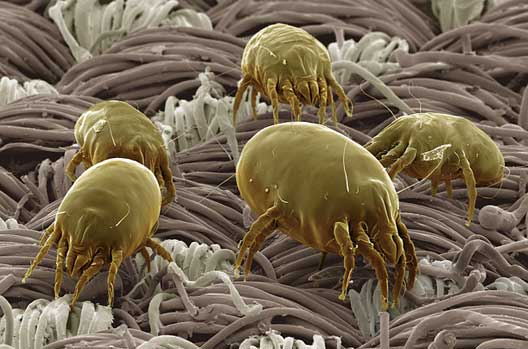
Dust mites allergies are not seasonal and cause health problems all year round. Though dust mites are microscopic and airborne, they can have a large role in the occurrence and severity of children's asthma.

Read More About This ArticleReduction of tiny particles such as these can help prevent many illnesses, general lethargy, sneezing, sore throats, headaches and other symptoms triggered by pollution.
Read More About This ArticleFreon is a refrigerant used for most home heating, ventilating, and air conditioning (HVAC) units in America. While only a brand name of DuPont, the name “freon” often represents all HCFC refrigerants. The makeup of freon includes hydrogen, carbon, fluorine, and chlorine, or HCFC (hydro chlorofluorocarbons).
Read More About This ArticleCommon problems with existing air conditioners result from faulty installation, poor service procedures, and inadequate maintenance. Improper installation of your air conditioner can result in leaky ducts and low airflow. Many times, the refrigerant charge (the amount of refrigerant in the system) does not match the manufacturer’s specifications. If proper refrigerant charging is not performed during installation, the performance and efficiency of the unit is impaired. Service technicians often fail to find refrigerant charging problems or even worsen existing problems by adding refrigerant to a system that is already full.
Air conditioner manufacturers generally make rugged, high quality products. However, an air conditioner’s filters, coils, and fins require regular maintenance for the unit to function effectively and efficiently throughout its years of service. Neglecting necessary maintenance ensures a steady decline in air conditioning performance while energy use steadily increases. Inadequate maintenance to components will cause the air conditioner will not work properly, and the compressor or fans are likely to fail prematurely. If your air conditioner fails, it is usually for one of the common reasons listed below:
Refrigerant Leaks: If your air conditioner is low on refrigerant, either it was undercharged at installation, or it leaks. If it leaks, simply adding refrigerant is not a solution. A trained technician should fix any leak, test the repair, and then charge the system with the correct amount of refrigerant. Remember that the performance and efficiency of your air conditioner is greatest when the refrigerant charge exactly matches the manufacturer’s specification, and is neither undercharged nor overcharged.
Electric Control Failure: The compressor and fan controls can wear out, especially when the air conditioner turns on and off frequently, as is common when a system is oversized. Because corrosion of wire and terminals is also a problem in many systems, electrical connections and contacts should be checked during a professional service call.
Air Conditioner Filters: The most important maintenance task that will ensure the efficiency of your air conditioner is to routinely replace or clean its filters. Clogged, dirty filters block normal airflow and reduce a system’s efficiency significantly. With normal airflow obstructed, air that bypasses the filter may carry dirt directly into the evaporator coil and impair the coil’s heat-absorbing capacity. Filters are located somewhere along the return duct’s length. Common filter locations are in walls, ceilings, furnaces, or in the air conditioner itself. Some types of filters are reusable; others must be replaced. They are available in a variety of types and efficiencies. Clean or replace your air conditioning system’s filter or filters every month or two during the cooling season.
Filters may need more frequent attention if the air conditioner is in constant use, is subjected to dusty conditions, or you have fur-bearing pets in the house. Regular maintenance of air conditioner coils, cooling fins, and fans will lead to a longer, more efficient service life.
Air Conditioner Coils: The air conditioner’s evaporator coil and condenser coil collect dirt over their months and years of service. A clean filter prevents the evaporator coil from soiling quickly. In time, however, the evaporator coil will still collect dirt. This dirt reduces air flow and insulates the coil which reduces its ability to absorb heat. Therefore, your evaporator coil should be checked every year and cleaned as necessary.
Outdoor condenser coils can also become very dirty if the outdoor environment is dusty or if there is foliage nearby. You can easily see the condenser coil and notice if dirt is collecting on its fins. You should minimize dirt and debris near the condenser unit. Your dryer vents, falling leaves, and lawn mower are all potential sources of dirt and debris. Cleaning the area around the coil, removing any debris, and trimming foliage back at least 2 feet (0.6 meters) allow for adequate air flow around the condenser.
Coil Fins: The aluminum fins on evaporator and condenser coils are easily bent and can block air flow through the coil. Air conditioning wholesalers sell a tool called a “fin comb” that will comb these fins back into nearly original condition.
Sealing and Insulating Air Ducts: Insulating air ducts prevents the loss of hot or cool air before it reaches individual rooms. An enormous waste of energy occurs when cooled air escapes from supply ducts or when hot attic air leaks into return ducts. Recent studies indicate that 10 percent to 30 percent of the conditioned air in an average central air conditioning system escapes from the ducts. For central air conditioning to be efficient, ducts must be airtight. Hiring a competent professional service technician to detect and correct duct leaks is a good investment, since leaky ducts may be difficult to find without experience and test equipment. Ducts must be sealed with duct “mastic.”
The old standby of duct tape is ineffective for sealing ducts. Obstructions can impair the efficiency of a duct system almost as much as leaks. You should be careful not to obstruct the flow of air from supply or return registers with furniture, drapes, or tightly fitted interior doors. Dirty filters and clogged evaporator coils can also be major obstructions to air flow. The large temperature difference between attics and ducts makes heat conduction through ducts almost as big a problem as air leakage and obstructions. Ducts in attics should be insulated heavily in addition to being made airtight.
Below are some tips, advice and maintenance guidelines for your outdoor air conditioner and/or heat pump. These tips are for better efficiency, longer life, and easier service.
Most of the information here applies to both air conditioners and heat pumps. But read carefully, some of the information is for one or the other. If you follow any of these tips make sure you know if you have a heat pump or an air conditioner or damage could result.
TIPS FOR BETTER EFFICIENCY:
1 – Set thermostat at one temperature. Constant adjusting can cause higher utility costs. If using your thermostat as a setback type, limit the setbacks to twice a day such as when you are at work and when you are sleeping. Only setback the thermostat 6% of desired temperature (approximately five degrees).
In heating, try not to set the thermostat below 65 degrees or above 75 degrees. Below 65 degrees a heat pump just won’t put out enough heat and above 75 degrees is using too much energy. In cooling, try not to set the thermostat below 70 degrees. Besides higher utility costs, this can cause the indoor coil to freeze and cause condensation in the house.
2 – Keep coils clean. If they get dirty you can use a heavy duty degreaser and hose them down. Just turn the unit off first.
3 – Don’t stack things on top of the unit. If the fan is on the top the air-flow cannot be restricted. Do not put your rolled-up garden hose or landscaping products on the unit. We see this all the time.
4 – When mowing the lawn, direct the mower away from the unit. A coil blocked with grass clippings and debris drastically reduces the efficiency.
5 – When using a weed whacker be careful near the unit. Debris can damage the coil, flatten the aluminum fins, and cut the thermostat wires; shorting out the transformer. We see this all the time and it is an expensive repair bill.
COMMON SENSE TIPS:
1 – Don’t plant prickly bushes like roses or holly around the unit. No one will want to service it.
2 – Don’t grow a garden or plant exotic flowers around the outdoor unit and expect the service technician to tip-toe around everything.
3 – When planting shrubs don’t block the access panels or the coil. Plan to keep 18 to 30 inches around the unit. Don’t forget to plan for the growth of the shrubs five, ten, even fifteen years down the road.
4 – Many people like to completely hide the outdoor unit behind shrubs. If you do this don’t be surprised if the technician refuses to service the unit. Please have some consideration and leave a path wide enough to accommodate the tech and his tools and room to work.
5 – Having crushed stone around the unit is best. It allows for good drainage, keeps the unit level and from sinking, keeps the coils clean from washed-up grass and dirt and also keeps the service technicians shoes clean. This will also keep your floors and carpeting clean.
6 – If building a fence around the unit allow for room to service, even replace the unit. If any major repairs need to be made, the service man may need access to all sides on the unit. Don’t expect the service tech to have to jump or climb over a fence. The unit needs to be serviced regularly. Install a gate that can be easily opened. We constantly see fences with out gates and the customer expects the tech to unbolt the fence and then re-install it when he is finished. Very Inconsiderate.
HEAT PUMPS ONLY:
1 – Keep snow, ice, and leaves away from the outdoor unit. This includes the top, sides, and bottom.
2 – Make it a habit to look at the outdoor heat pump during the winter months for signs of excessive ice or snow build-up on or around the heat pump. Especially after bad weather.
If the unit is covered in ice or snow it must be removed for it to work properly. Turn the thermostat to Emergency heat or off and remove the snow and ice. You can pour warm or hot water over the unit to melt the snow and ice. Even cold water from a hose will help. Do not use any sharp objects to pick or knock the ice off the coils of the heat pump. This could cause severe damage and personal injury. Once the unit is clear of snow and ice turn the thermostat back to normal heating. If the unit ices up again, call for service.
3 – Do not let the outdoor unit sit underneath a leaking gutter. In the winter months, water will drip on the top of the unit and freeze solid. This will restrict the air flow and cause the whole unit to freeze-up.
4 – Heat Pumps should be elevated 4 to 8 inches above ground level to keep coils clear of snow and ice and to allow for proper drainage. Contact our Service Department if you would like your unit raised.
AIR CONDITIONERS ONLY:
1 – Cover the outdoor unit including top and sides in the fall and winter when the air conditioner is not in use. Great for areas with lots of trees where falling branches can damage the unit. Also keeps heavy ice from bending the fan blades and hale from damaging the coil.
Caution, this is for air conditioners only, not heat pumps and make sure the unit is off. Do not attempt to run the air conditioning with the outdoor unit covered. Also remember to remove the cover in Spring before turning on the air.
If a room is not getting cooled or heated like the other rooms, it’s very likely there are some simple checks to do before calling your service company. Here are some checks:
- Check the air filters – both at the intake and return if any. They may be dirty or blocked.
- Check the air registers to the room(s). Are they open, blocked/covered? If they are not, are the windows/doors sealed around the frame? You may have a room that is not well insulated.
- If there is less air flow through the register, it’s likely the air duct to the room is long, has some restrictions, or a damper may be partially closed. Check the ductwork if it’s in the basement or attic. Open the damper if there’s one.
Simple steps like sealing window and door gaps, drawing the curtains when it’s the height of summer, and closing registers in un-used rooms can only help your A/C and reduce energy bills.
We can do a thorough inspection and energy audit of your home, so give us a call to save on your energy bills this season.
If a room is not getting cooled or heated like the other rooms, it’s very likely there are some simple checks to do before calling your service company. Here are some of the checks you can perform:
- Check the air filters – both at the intake and return if any. They may be dirty of blocked.
- Check the air vents to the room(s). Are they open, blocked/covered?
- If there is less air flow through the register, it’s likely the air duct to the room is long, has some restrictions, or a damper may be partially closed. Check the ductwork if it’s in the basement or attic. Open the damper if there’s one.
- If there is low air pressure coming from all the room vents, it’s likely that the fan motor speed is not right. This does require a professional, so give us a call today.
The thermostat setting is way down, but the room temperature still feels warm. There are usually two causes for this:
1. All thermostats are not equal. Do you have one of the dial types? They are the older mechanical type thermostats that must be calibrated at least once every two years or so. You are better off buying a new digital thermostat that will pay for itself in one summer.
Mechanical or digital – it’s also likely that the thermostat could have been placed in the wrong location – near a heat source, sunlight, or an un insulated wall. This is very common but a problem to fix. Repositioning the thermostat will require some knowledge of electrical wiring and fishing wire through a drywall can be a challenge.
Your best bet will be to protect the thermostat from obvious heat/cold source, and if that fails, then you will need to call in your expert service company to reposition and rewire the thermostat.
This will save you money on your energy bills in the long run.
2. The more serious problem is that your condenser coils are freezing up – this can happen during the cooling season. Try turning off the system for an hour or two (don’t worry, the unit was not cooling anyway!). Turn the system back on and see if there’s cool air coming from the vents. If not, the problems could be a leak in the system, lack of refrigerant, or dirt in the system that’s blocking the condenser unit. This does require a professional, so give us a call today.
This is a common problem and you should check for the following before calling for a service technician:
- Check the power cable, breaker first. Remember if you’re not sure call for service.
- Check the thermostat: in summer it could be set too high, in winter it could be set too low
- Check the condensate drain pump. The float could be stuck, drain blocked, or the pump may be off.
Beyond these simple checks, you will need a professional HVAC technician, so give us a call today.